AI Agents:
Done Right.
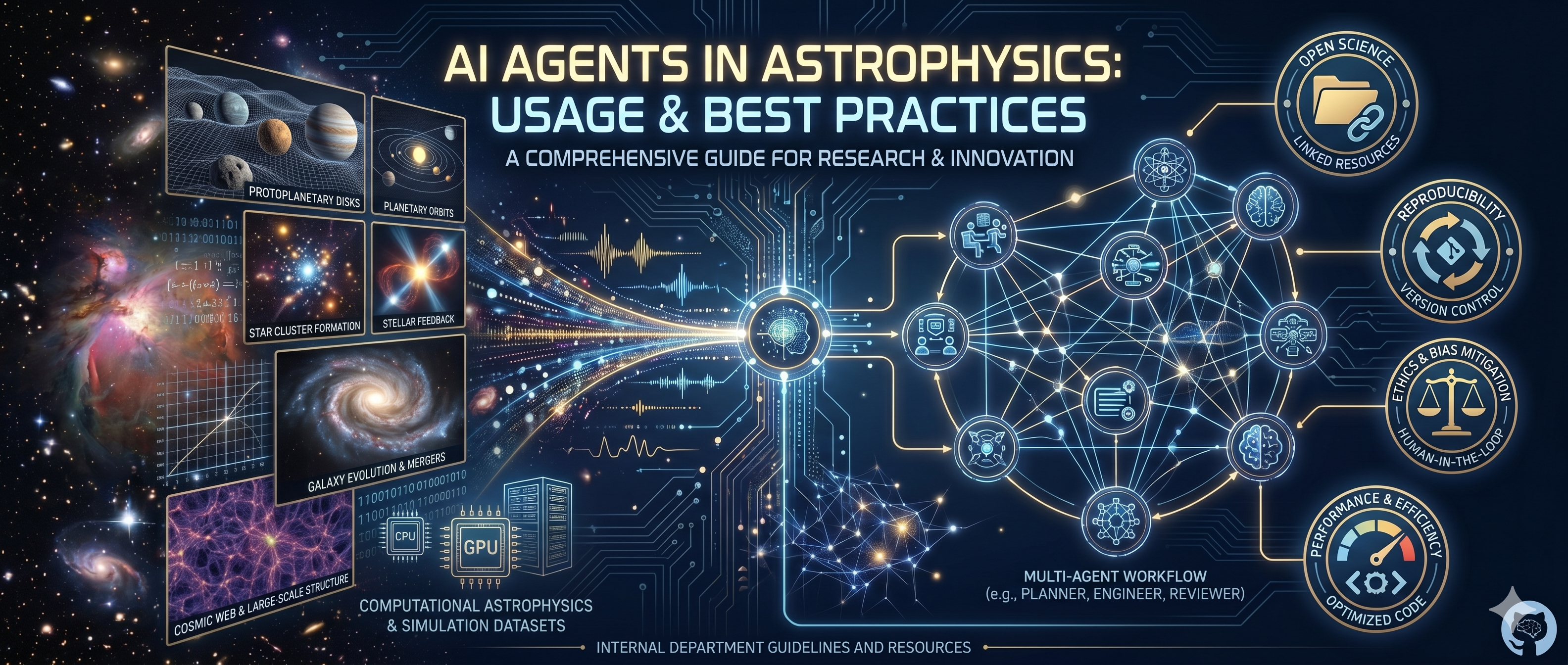
Who's in the Room?
GitHub Copilot Billing: PRUs → AI Credits
| Feature | Pre-June 1 | From June 1 |
|---|---|---|
| Unit | PRU (300/month) | AI Credits (1000/month base + 500 flex) |
| Inline completions | Free ∞ | Free ∞ |
| Chat / Agent cost | 1 PRU / turn | Per token (in + out) |
| Large context | No penalty | Drains credits faster |
| Empty quota | Fallback model | Hard stop — chat locked |
vs 1 PRU before · student budget ≈ 1 000 credits/month
15-step agent loop → 10–20 credits in one sitting
Tab autocomplete & Next Edit Suggestions — zero cost
- Write precise prompts — fewer turns
- Attach only relevant files, not
@workspace - No credits = no chat until next month
We're no longer debating whether agents work.
We're debating how to make them reliable, reusable, and composable.
It's better infrastructure around the model.
Today's Agenda
From Chatbot to Agent: Key Distinctions
- Single-prompt, single-response
- No memory across sessions
- No tools or external data calls
- One-shot text generation
- You fix errors manually
- Plans & executes multi-step tasks
- Uses tools: code, web, files, APIs
- Iterates, self-corrects on errors
- Can spawn sub-agents (multi-agent)
- Example: write → run → debug → plot
entire SED fitting pipeline
Anatomy of an Agent Loop
repo, memory
actions
bash, APIs, files
check errors
Python/bash executor · ADS MCP (live literature) · astropy / emcee / sherpa · FITS file reader · matplotlib PDF output
Beyond the Single Agent: Why Orchestration?
Single LLMs lack persistent memory, cannot self-verify numerical results, and cannot run external tools in a closed loop. Scientific agents must integrate domain-specific knowledge, process diverse data types, and ensure rigorous reproducibility — tasks that demand coordinated specialist agents. (Ren et al. 2025, arXiv:2503.24047)
Fixed roles + Standardised Operating Procedures. Assembly-line workflow (manager → architect → engineer) produces structured artefacts, reducing cascading hallucinations from naive LLM chaining.
"Conversation programming": customisable agents interact through structured dialogues, each combining LLMs, human input, or tools. Spans maths, coding, operations research.
Planner↔reviewer loop → control agent executes. Four building blocks: planner, memory module, action space, verifier. Removes human-in-the-loop from routine steps while preserving structured oversight.
Prompt sampler → LLM generates code diffs → evaluators score → database updated iteratively. No human-authored templates. AI Scientist-v2: first fully AI-generated peer-review-accepted workshop paper.
What Has Been Demonstrated — and Where It Fails
System design 44% · Inter-agent misalignment 32% · Verification failures 24%.
Performance gains on benchmarks remain minimal vs single-agent. Better base models alone will not fix these — good organisational design is required.
- No formula for how many agents, which roles, how they interact
- Semi-autonomy outperforms full autonomy for hard science
- Scientific agents need built-in validation (self-review, statistical checks)
- No community standard for citing or archiving multi-agent workflows
GitHub Copilot: What You Already Have for Free
Tab-complete as you type. Context-aware completions for astropy, numpy, matplotlib.
(Ctrl+Alt+I)
Ask questions, explain code, generate functions, fix bugs. In sidebar or inline.
(VS Code)
Multi-file, multi-step tasks. Runs terminal, self-heals errors. GA on VS Code & JetBrains.
(Cloud)
Assign a GitHub Issue → Copilot opens a PR autonomously. You review and merge.
IDE Landscape: Cursor, Windsurf & Google Antigravity
| Feature | VS Code + Copilot our baseline |
Cursor VS Code fork · Anysphere |
Windsurf Codeium IDE |
Google Antigravity Standalone · Google |
|---|---|---|---|---|
| Base IDE | VS Code (Microsoft) | VS Code fork (Anysphere) | Proprietary (Codeium) | Standalone (Google) · local install |
| Cost (May 2026) | Free (GitHub Education) | Free tier + Pro $20/mo | Free tier + Pro $15/mo | Free for developers |
| Autocomplete | Good — Copilot inline suggestions | ⭐ Best — "predict next edit", context-aware across files | ⭐ Strong — flow-aware, pattern-continuing | Not its focus — agent-first, not autocomplete-first |
| Agent UX | Agent Mode (chat panel in editor) | Composer + agent-management UI in editor | Cascade — fully integrated, terminal-aware | Agent Manager separate from editor — "control room": agents run while editor stays as review surface |
| Model choice | GPT-4o · Sonnet · Gemini | Sonnet · GPT-4o · Gemini · local | Sonnet · GPT-4o · own models | Gemini · Claude · GPT-OSS · local |
| MCP / Extensions | ✅ MCP · ✅ All extensions | ✅ MCP · ✅ Most extensions | ✅ MCP · ⚠️ Limited extensions | ✅ MCP · ✅ VS Code-compatible |
| Remote SSH / HPC | ✅ Full Remote SSH | ✅ Partial | ⚠️ Limited | ⚠️ Local-first; Antigravity CLI works over SSH |
| Best used for | Daily research — modular, composable with Claude Code CLI | Heavy cross-file refactoring, polished AI editing | "Vibe coding", greenfield projects, flow state | Parallel multi-agent tasks — run alongside VS Code, not instead |
Demo: Dust Growth & Fragmentation with DustPy
from dustpy import Simulation
from dustpy import constants as c

sim = Simulation()
sim.ini.star.M = 1.0 * c.M_sun
sim.ini.disk.alpha = 1.e-3
# ↑ Copilot completes
#   the ini block from
# context.You: Why does a_max drop sharply at 150 au in my dust surface density plot?
Copilot: That's the fragmentation barrier
a_frag = 2Σ v_frag² / (3π α ρ_s c_s²).
At large r, α·c_s² drops, so fragmentation limits growth earlier than drift.
"Use the DustPy skill. Run ice-line v_frag simulation (v_frag=1 m/s inside 150 au, 10 m/s outside). Plot Σ_dust(r,t) and a_max(r). Save PDF to plots/."
- ✅ Loaded
dustpy/SKILL.md - ✅ Wrote
run_ice_line_vfrag.py - ✅ Ran simulation · 10 snapshots
- ✅ Caught
ModuleNotFoundError, fixed - ✅ Saved
plots/dust_amax.pdf
.github/skills/dustpy/SKILL.md first — getting DustPy's CGS unit
conventions, sanity checks (St < 1, a_max < a_frag), and the mandatory
SimulationHandoff/v1 schema — before writing a single line of code.
Two Config Files, One Source of Truth
.github/copilot-instructions.md — group-level, permanent
## Coding standards
- Python 3.11+; astropy, sherpa, emcee, corner
- Physical units via astropy.units; propagate errors
- Figures: 300 dpi, tab10 palette, PDF + PNG

## References
- Verify ALL citations via NASA ADS first
- ADS bibcode format: 2016A&A...594A.116H
- NEVER invent author names, DOIs, or bibcodesAGENTS.md — project-specific, per paper
## Project: NGC 1275 X-ray Spectral Analysis
**PI**: J. Doe  |  **Domain**: x-ray

## Scientific context
- Data: XMM-Newton EPIC-pn, 0.5–10 keV
- Model: TBabs*powerlaw
- Galactic nH = 1.2e21 cm⁻² (fixed; HI4PI 2016)
- Fit band: 0.5–7.0 keV; statistic: C-statcopilot-instructions.md is Copilot-only — keep it to group conventions
that never change between projects.
AGENTS.override.md (gitignored).Rule: the more domain context you give the agent upfront (obs IDs, model assumptions, known issues, current hypothesis), the fewer hallucinations you get. Specificity is safety.
Agent Skills: Teaching Copilot Repeatable Procedures
An Agent Skill is a structured prompt document that tells an agent how to perform a specific task — including which tools to use, what steps to follow, and how to handle errors. Think of them as reusable SOPs for your agent.
- Encode domain knowledge once, reuse across projects
- Make agent behaviour consistent and auditable
- New group members can onboard via shared skills
- Skills can be versioned and cited in Methods
- Reduce prompt drift between collaborators
2.4k forks — active community repo. Skills for: data analysis, paper writing,
literature review, coding. Each skill: SKILL.md with explicit steps, example prompts,
expected outputs. Drop into .github/ alongside copilot-instructions.md.
💡 VS Code 1.99+: agent files must end in
.agent.md — plain .md is silently
ignored.
Writing a SKILL.md in 3 Steps
---
name: my-skill
description: >
  One sentence the agent uses to decide
  whether to load this skill. Include
  trigger phrases here.
---## Workflow
1. Load AGENTS.md and identify target.
2. Call `@literature-agent` to verify params.
3. Run script; validate output units with
`astropy.units`.
4. Save figure to `plots/` at 300 dpi.
5. Emit handoff JSON.## Iron rules
> NEVER invent a bibcode.
> ALWAYS use astropy.units.
## Anti-patterns
| Wrong | Why | Correct |
|---|---|---|
| Hardcode kpc | breaks units | use u.kpc |alma-imager.agent.md---
name: alma-imager
description: >
Produce a CLEAN image from ALMA measurement
set. Trigger: ALMA, CLEAN, tclean, dirty map,
beam, synthesized beam, continuum image.
tools: [read, edit, execute]
---
## Role
Run CASA tclean on a calibrated ALMA MS.
## Workflow
1. Read AGENTS.md — get MS path and target name.
2. Check beam size; warn if < 2 px/beam.
3. Run tclean (briggs, robust=0.5).
4. Export FITS to data/images/.
5. Validate: peak SNR ≥ 5 else flag.
6. Emit {image_path, beam_arcsec, rms_uJy}..github/agents/alma-imager.agent.md📁 Large code blocks →
.github/agents/references/🔑 Trigger phrases in
description: control when the agent auto-loads the skill♻️ Reuse across projects by committing to group template
MCP in Plain English: Before and After
- You ask ChatGPT: "find papers on gap opening criterion"
- ChatGPT invents 3 plausible-looking bibcodes (hallucination)
- You search ADS manually for each one — 2 don't exist
- You copy the real BibTeX by hand into your
.bibfile - You paste the BibTeX back to ChatGPT for the next question
- Total: ~10 min per reference · error-prone · not reproducible
- You type: "find papers on gap opening criterion"
- Copilot calls
ads_search()via the ADS MCP server - ADS returns real bibcodes, titles, abstracts
- Copilot calls
ads_export()→ verified BibTeX - Agent appends to
paper/bibliography.bibautomatically - Total: ~5 sec · zero hallucinations · logged in
prompts/
in VS Code Chat
picks tool
local process
real data
verified BibTeX
.vscode/settings.json.
What Is MCP? Giving Agents Real-World Tools
Model Context Protocol (MCP) is an open standard that lets any AI agent call external tools — databases, APIs, file systems — through a consistent interface. Think of it as a plugin system for agents.
or Agent Mode
tool to call
or remote API
FITS, DB
An Emerging Ecosystem: Astronomy MCP Servers
ADS MCP Servers: Ground Truth for References
search_papers— full Solr syntax queryget_record— full metadata by bibcodeget_bibtex— export BibTeX directlyget_citations— who cited this paper?get_references— what does it cite?citation_metrics— h-index, i10, totalsmanage_library— reading lists
- Search papers by keyword / author / year
- Get abstracts, arXiv IDs, DOIs
- Export BibTeX for individual papers
- Citation metrics (h-index etc.)
- Manage personal ADS libraries
- Natural language paper discovery
- Works with Claude Desktop & VS Code
pip install / uvx install → add ADS_API_TOKEN
env var → add server block to VS Code settings.json → done
Wiring the ADS MCP into VS Code
settings.json:
// .vscode/settings.json
"mcp": {
  "servers": {
    "ads": {
      "command": "uvx",
      "args": ["--from",
        "git+https://github.com/cbyrohl/mcp-server-ads",
        "mcp-server-ads"],
      "env": {
        "ADS_API_TOKEN": "YOUR_TOKEN"
      }
    }
  }
}Without MCP, GPT-4o/Copilot invents plausible-but-wrong bibcodes, authors, and journal names — every time.
Known Pitfalls of AI Agents in Scientific Research
The Eight Failure Modes to Watch For
Hallucination Prevention: A Science Checklist
astropy.units. Never accept bare floats for physical
quantities. Unit errors are invisible until they cascade.[DATA MISSING: …] sentinel — agents must halt and flag, not fabricate values they don't
have.AGENTS.md — survive context window rotation and model
switches. "NEVER invent a bibcode" repeated in every agent.doi= check — blocks commits with hand-written BibTeX entries
missing a DOI field. Last-line defence before git push.Mitigation Strategies: Keep Humans in the Loop
-
1
Define no-go zones for autonomy: Decide which tasks can the agent do alone (boilerplate code, reformatting, lit search) vs. which MUST have human review (model selection, physical interpretation, statistical thresholds).
-
2
Checkpoint derivation steps: For any analysis with physics equations, manually re-derive the key steps. If the agent's output can't be checked by hand, the task is too autonomous. ReplicationBench shows agents fail here most.
-
3
Run agents on synthetic data first: Before unleashing an agent on your real science data, test on a toy dataset with known answers. If the agent doesn't recover ground truth, don't trust it with your precious observations.
-
4
Compare agent output to a naive baseline: Does the AI-assisted result actually beat what you'd get in 20 minutes yourself? Huang 2026 found many AI modes did not outperform unassisted work.
-
5
Version-control runs; automate quality gates: Commit data, prompts, config, and output together in Git. pre-commit hooks enforce code style, block files >5 MB, and reject BibTeX entries missing
doi=.
The Reproducibility Challenge: AI Adds New Wrinkles
Even temperature=0 doesn't guarantee identical outputs across model versions. Copilot's base
model changes silently.
Copilot reads your whole repo. The same prompt with a different codebase gives different code. Context is invisible.
GPT-4o of today ≠ GPT-4o of six months ago. Updates happen without notification. 'I used Copilot' isn't enough.
If you don't record your prompts, no one — including future-you — can reproduce your AI-assisted analysis.
Making AI-Assisted Research Reproducible
prompts/ directory. One .md file per analysis task with
date + model version.PROMPTS.md or prompts/ to Zenodo
alongside code & data.CITATION.cff — GitHub shows 'Cite this repository' and Zenodo/Zotero extract metadata
automatically.
Template: prompts/xray_spectral_fit.md
# prompts/xray_spectral_fit.md

## Metadata
- Date: 2026-04-15
- Tool: GitHub Copilot (GPT-4o), VS Code Agent Mode v1.116
- Purpose: Generate sherpa X-ray spectral fitting script
- Output: src/fit_spectrum.py

## Prompt used
Write a Python script to fit XMM-Newton EPIC-pn spectra in 0.5-10 keV
with TBabs*powerlaw using sherpa + CSTAT. Fix nH=1.2e21 cm^-2.
Return Gamma and norm with 90% confidence. Save chi2 residual as PDF.

## Validation log
- [x] Runs without errors on test data (spec.pi, back.pi, rmf.rmf)
- [x] Gamma matches manual XSPEC fit to within 2%
- [x] All references checked in NASA ADS — no hallucinations foundfit_spectrum.py → full reproducibility provenance lives in your Git
history
What All Journals Agree On
Authors remain solely responsible for all content, regardless of how AI was used. AI tools cannot satisfy authorship criteria.
Disclose the tool, version, purpose, and section. The threshold is content generation, not volume of use.
LLMs cannot approve manuscripts, hold copyright, or be accountable. They may not appear in any author list.
How Our Journals Compare
| Journal / Publisher | AI Author? | Disclose Where? | Copy-Edit Exempt? | AI Figures? | Strictness |
|---|---|---|---|---|---|
| MNRAS (Oxford/RAS) | ❌ No | Methods or Ack. | Not explicit | Not explicit | Moderate |
| A&A (EDP Sciences) | ❌ No | Methods preferred | ✅ Yes | Not explicit | Moderate |
| ApJ / AJ (AAS/IOP) | ❌ No | Cover letter + Methods | Not specified | Not explicit | Moderate |
| Nature / Nat. Astron. | ❌ No | Methods (required) | ✅ Yes | ❌ Banned | Strict |
| Science (AAAS) | ❌ No | Cover letter + Methods or Ack. | Not specified | ❌ Banned* | Very Strict |
| Springer Nature (all) | ❌ No | Methods (required) | ✅ Yes | ❌ Banned | Strict |
MNRAS and A&A: Moderate, Practical Policies
- AI cannot be listed as author
- Disclose in Methods OR Acknowledgements
- Cover letter disclosure also expected
- No explicit copy-editing exemption (err on side of disclosure)
- No explicit AI image ban (but integrity rules apply)
- Oxford Academic screens for NLP tools in submitted author lists
- AI cannot be listed as author
- Disclose in Methods section (preferred)
- Copy-editing AI EXEMPT — explicit policy (grammar, clarity, language only)
- AI-generated code = AI content: must be disclosed
- Authors verify all AI-assisted content for accuracy
Nature and Science: The Strictest Policies
- AI cannot be listed as author
- Disclose in Methods (required) — not in Acknowledgements alone
- AI-generated IMAGES are BANNED: figures, graphical abstracts, all
- Copy-editing AI exempt (Grammarly-style)
- Specific tool + version + purpose required
- Reviewers may NOT upload manuscripts to any AI tool
- AI may not be used inappropriately — editors may decline manuscript
- Disclose in cover letter + Methods or Ack. (location depends on use case)
- AI-generated images/multimedia BANNED without explicit editor permission*
- AI tools cannot be cited as sources (AI cannot be a paper author)
- Authors fully accountable for accuracy, citations, and bias
- Reviewers may NOT upload any part of a manuscript to an AI tool
Copy-Paste Disclosure Statements
Quick Reference: What to Disclose, Where
| Action | Disclose? | Where? | Notes |
|---|---|---|---|
| Used Copilot to write analysis code | Yes | Methods | Core case for us — always disclose |
| Used ADS MCP for reference retrieval | Yes | Methods | Name the server & token source |
| Used Copilot to draft Methods text | Yes | Methods | All journals require this |
| Used Copilot for Discussion section | Yes | Methods | Science AAAS: full prompt required |
| Grammar / spelling / English only | Generally No | — | A&A & Nature explicit exemption |
| Used Copilot to make figures | Yes + check | Methods + caption | Nature/Springer: AI figures BANNED |
| Used ADS for literature search (no MCP) | Yes (best pr.) | Methods/Ack. | Good practice; not yet mandated |
| Used Copilot to respond to referees | Yes (best pr.) | Cover letter | Emerging norm, protects integrity |
Costs & Budget: What Does AI Actually Cost?
- GitHub Copilot — free for students & verified faculty via GitHub Education (unlimited chat + agent mode)
- Claude.ai — free tier (Claude Sonnet, limited messages / day)
- ChatGPT — free tier (GPT-4o, rate-limited)
- Gemini — free via Google AI Studio (1M context)
- Ollama — free, fully local, runs on your laptop
- Copilot Pro €10 / mo — higher premium-request quota
- Claude Max €18 / mo — unlimited Sonnet, Projects, Opus access
- OpenAI Plus €20 / mo — GPT-5, o4-mini, DALL·E
- Anthropic API ~€3 / M tokens (Sonnet), ~€15 (Opus)
- OpenAI API ~€2.50 / M tokens (GPT-4o)
- Frame as reproducible research infrastructure — like compute time on LRZ
- Typical researcher: €20–50 / month covers heavy daily use
- Ask IT: check for LRZ / TUM / LMU institutional licence (Microsoft M365 Copilot)
- Grant line: "AI-assisted analysis tools" in DFG / ERC proposals is accepted
- Template: "I request €X/month for AI API access to support reproducible research in [domain]…"
Key Takeaways
.github/copilot-instructions.md teaches Copilot your project once,
forever.Fork It, Configure It, Go
- 5 domains: disk · cosmo · retrieval · LSS/MW · X-ray
copilot-instructions.md— your lab's conventions, onceAGENTS.md— project-specific context per repoARCHITECTURE.md— agent roster & 9-stage pipeline diagrampipeline-agent.agent.md— 9-stage research pipeline orchestratorhypothesis-agent.agent.md— ranked hypothesis generation + ADSanalytical-agent.agent.md— SymPy pre-analysis & scale estimatessetup-agent.agent.md— config files + SLURM/PBS job scriptsanalysis-agent.agent.md— simulation post-processing & figuresinterpretation-agent.agent.md— physical interpretation, Gate 2spectral-agent.agent.md— X-ray spectral fitting (Sherpa)mcmc-agent.agent.md— emcee posteriors, 68% CIspaper-agent.agent.md— LaTeX manuscript + ADS citations + auto-reviewliterature-agent.agent.md— ADS-verified citationssimulation-agent.agent.md— FARGO3D/GADGET simsretrieval-agent.agent.md— petitRADTRANS retrievals- Skills:
dustpy·fargo3d·pluto·radmc3d·yt·sherpa envs/base.yml— conda env, pinned versions.pre-commit-config.yaml— style + BibTeXdoi=checksCITATION.cff— GitHub 'Cite this repository'
- Extensions pre-configured via
.vscode/extensions.json— install once, share with team - ADS MCP pre-wired — Copilot fetches verified BibTeX, no hallucinated DOIs
- pre-commit + CI enforce style, file-size limits, and
doi=on every commit CITATION.cfftriggers GitHub's 'Cite this repository' button- Zenodo and Zotero extract structured metadata automatically
- GitHub Pages docs at giovannipicogna.github.io/lmu-usm-agent-template
5 Science Domains, 1 Template
| Domain | → Agent | Key Libraries |
|---|---|---|
| Disk formation | simulation-agent |
dustpy, FARGO3D, radmc3dPy |
| Cosmological sims | simulation-agent |
yt, Magneticum, fargopy |
| Atmospheric retrieval | retrieval-agent |
petitRADTRANS, dynesty |
| LSS & Milky Way | mcmc-agent |
astropy, emcee, nbodykit |
| X-ray spectroscopy | spectral-agent |
sherpa, XSPEC, emcee |
- agents page — all 12 agents with example invocations
- skills page — bundled skills by domain
- Auto-deployed on every push to
mainvia GitHub Actions
Settings → Pages → Source: GitHub Actions
copilot-instructions.md §11: domain-specific skill lists for every research area
Local Models for Sensitive Data (Ollama / LM Studio)
- Embargoed or proprietary observational data (pre-publication)
- Unpublished simulation outputs (IP of your group)
- Patient / medical data — EU GDPR compliance
- HPC login nodes without outbound internet access
- Budget constraints — zero API cost once hardware is available
- Offline development or conference travel
# Install (macOS / Linux)
curl -fsSL https://ollama.com/install.sh | sh

# Pull a capable science-friendly model
ollama pull qwen2.5-coder:14b   # 9 GB — strong at code

# Serve (auto-starts on install)
ollama serve   # listens on localhost:11434

# Use with VS Code Copilot Chat
# Settings → Copilot → Chat Model → "ollama/qwen2.5-coder:14b"| Model | Size | Best for |
|---|---|---|
qwen2.5-coder:7b |
4 GB | Quick code edits |
qwen2.5-coder:14b |
9 GB | Analysis scripts |
llama3.3:70b |
40 GB | Complex reasoning |
gemma3:27b |
17 GB | Scientific writing |
localhost:11434 — drop-in replacement; no code changes needed in your analysis scripts.
Benchmark Reality Check: AI Agents in Astrophysics
111 tasks · 20 peer-reviewed astrophysics papers · tasks co-written by original authors
success rate for best frontier models
- Tasks include: Abacus N-body near-field summation with spline softening; B-spline localisation of black-hole merger-rate peaks in mass
- Failure mode: coding is fine — domain-specific rigor is not
120 tasks · 100 synthetic + 20 real RV datasets · multi-planet systems
- Agents achieve optimal statistical fits on periodograms — but fail to recover true Keplerian elements
- Difficulty scales with: SNR, orbital resonances, planet multiplicity
- Root cause: no persistent physical world model — statistical optimisation ≠ physical understanding
Agent Systems Built for Astrophysics & Cosmology
- Task: ACT DR6 CMB power-spectrum analysis
- PI + Student agent hierarchy
- Shared "Blackboard" for async cross-agent memory retention
- Open-ended: hypothesis → computation → diagnostic iteration
- Closest analogue to our
@pipeline-agentdesign
- Task: out-of-distribution detection in weak-lensing maps
- Structured tree-search + dedicated idea sampler
- Iteratively refines detection algorithms against known physical bounds
- Excels where objectives are mathematically precise and measurable
- Task: end-to-end paper generation
- Autonomously applies quantum-physics methods to astrophysical datasets
- Expert-validated papers in astrophysics, planetary science, mathematical physics
- Still requires domain expert review — not autonomous publishing
Our SKILL.md Approach: Evidence & What to Watch
+26.7 percentage points vs baseline — zero fine-tuning required
- 199 domain-specific SKILL.md files (biostatistics, data analysis, scientific writing)
- Agent reads structured Markdown → applies domain knowledge dynamically at inference time
- Directly validates our
dustpy,pluto,fargo3d,radmc3d,sherpa,ytskills
- Audit of 111 M references across 2.5 M arXiv + PubMed papers
- ≥146,932 entirely hallucinated references introduced in 2025 alone
- Risk compounds: agents using RAG on poisoned literature generate recursively invalid science
- Agents optimise toward the objective you provide — problem selection remains human
- True autonomy requires scientific judgment trained on grant reviews and rejections — not yet available
- Current role: powerful co-scientist, not independent PI
@hypothesis-agent: Planet Gap Mechanisms
Science question:
"What mechanisms set the depth of a planet-carved gap in a protoplanetary disc? Vary M_p, α, and v_frag."
Agent ran 3-round internal debate → cross-checked NASA ADS
α simultaneously sets the gas gap depth through the Kanagawa K-parameter and the fragmentation-limited grain size via afrag ∝ vfrag^2/α. Both effects reduce grain Stokes number and dust trapping efficiency as α increases, so the dust gap scales steeper than the gas gap alone.
By analogy with the Kanagawa gas formula, a modified dimensionless parameter Kdust=(Mp/M∗)^2 (h/r)^(−5)α^(−1)(vfrag/cs)^(−2) should collapse gas and millimetre-dust gap depths onto a single power-law across the full (M_p, α, v_frag) parameter space.
v_frag controls the fragmentation-limited Stokes number at the outer gap edge. High v_frag → large grains → St ∼ 0.1 → efficient pressure-bump filtration → dust gap much deeper than gas gap. Low v_frag → small grains → St ≪ 0.01 → poorly trapped → dust/gas gap depth ratio near unity.
results/hypotheses/gap_depth_hypotheses_20260529.json
· wall-clock ~30 s · priority rank: [1, 2, 3]
@analytical-agent: Gap-Opening Mass Thresholds
Hypothesis: "1 M_Jup planet
opens deep gap in M★=1 M⊙ disc
with h/r=0.05, α=1e-3."
Compute gap-opening criteria
and Kanagawa gap depth.
- Thermal gap-opening mass: M_th = 0.393 M_Jup (3 M★ h³)
- Viscous gap-opening mass: M_visc = 0.093 M_Jup (K=25 threshold)
- Kanagawa parameter: K = 2916 for q = 9.55×10⁻⁴
- Gap depth: Σ_gap/Σ₀ = 8.5×10⁻³ (118× gas depletion)
- Regime: deeply nonlinear (K/K_open = 116.6)
Σ_gap/Σ₀ = 1/(1 + 0.04 K) K = q² / (h⁵ α)
All quantities propagated with
astropy.units — no bare floats
results/analytical/gap_depth_analytical_20260529.py +
.json · reproducible script runs in <1 s
@literature-agent: Fragmentation Barrier Papers
Find the key papers on the fragmentation barrier in dust coagulation and export BibTeX to paper/bibliography.bib
- 6×
ads_searchqueries ads_resolve_referencefor 2 ambiguous refsads_citation_helperon 7-paper core setads_exportbatch → BibTeX, 1 call for all 12
- 2012A&A...539A.148B — Birnstiel+ 2012 (739 cit.) — the fragmentation barrier formula
- 2008A&A...480..859B — Brauer+ 2008 (591 cit.) — coagulation + radial drift
- 2010A&A...513A..79B — Birnstiel+ 2010 (579 cit.) — two-population model
- 2010A&A...513A..57Z — Zsom+ 2010 (504 cit.) — bouncing barrier
- 2010A&A...513A..56G — Güttler+ 2010 (439 cit.) — collision outcome mapping
- + 7 more: Weidenschilling 1977, Blum & Wurm 2008, Birnstiel 2011/2016, Windmark 2012, Testi 2014, Stammler 2023
- No hand-written BibTeX — every entry from live ADS query
- All 12 entries carry
doi+adsurlfields - Keys auto-renamed to
AuthorYYYYformat - Zero hallucinated references
paper/bibliography.bib · validated with
grep -c "^@" → 12 · wall-clock ~45 s
@setup-agent: FARGO3D Par File + SLURM Script
Generate FARGO3D par file for
gap depth run: 1 M_Jup at 20 au,
M★=1 M⊙, h/r=0.05, α=1e-3,
Nx=384×Ny=128.
Add SLURM script for LRZ.
data/runs/gap_1Mjup/gap_1Mjup.par— patched FARGO3D pardata/runs/gap_1Mjup/planets/gap_1Mjup.cfg— planet configdata/runs/gap_1Mjup/submit.sh— LRZ SLURM script
⚠️ Initial attempt used fargo setup (no α support).
Agent detected mismatch and corrected to fargo_nu setup
(Shakura-Sunyaev viscosity) — without user prompt.
SLURM script: 48 cores, LRZ SuperMUC-NG, wall-time 24 h
dustpy skill: Ice-line Fragmentation Run
python .github/skills/dustpy/\
  scripts/run_dustpy.py \
  --alpha 1e-3 \
  --disk-mass 0.05 \
  --stellar-mass 1.0 \
  --r-in 1 --r-out 100 \
  --N-r 80 \
  --vfrag 10 \
  --t-end 1e6 \
  --N-snaps 10 \
  --output-dir data/dust/iceline_test
- Disk: 0.05 M⊙ · R ∈ [1, 100] au · 80 radial cells
- Turbulence: α = 10⁻³ (Shakura-Sunyaev)
- Fragmentation velocity: v_frag = 10 m s⁻¹
- Evolution: t_end = 1 Myr · 10 snapshots
- N_snaps ≥ 10 (min constraint validated)
- Grid geometry checked before run
- Output:
data/dust/iceline_test/data*.hdf5 - Diagnostics: grain size, Stokes number, dust/gas ratio vs radius
fargo3d skill: Patch .par + Launch Simulation
python .github/skills/fargo3d/\
  scripts/run_fargo3d.py \
  --par-file setups/fargo/fargo.par\
  --output-dir data/runs/fargo_test\
  --AspectRatio 0.05 \
  --Sigma0 6.37e-4 \
  --PlanetMass 9.548e-4 \
  --Tmax 5 --Ninterm 5 \
  --fargo3d-bin fargo3d \
  --n-procs 1
- Binary detected:
fargo3d(sequential build) - Par file patched: AspectRatio, Sigma0, PlanetMass, OutputDir
- Absolute path passed to binary (cwd fix applied)
- Output:
gasdens*.dat,orbit0.dat,tqwk0.dat
Script passed relative par path while binary's cwd was set to the FARGO3D source dir → "Unable to read par file".
Fix: pass os.path.abspath(patched_par) — binary now
resolves the path correctly.
.github/skills/fargo3d/scripts/run_fargo3d.py · demonstrates live agent
self-correction during demo
pluto skill: Compile Disk_Planet Problem
python .github/skills/pluto/\
  scripts/compile_pluto.py \
  --run-dir .../Test_Problems/\
             HD/Disk_Planet \
  --pluto-dir .../pluto-code \
  --with-fargo \
  --make-jobs 4
- Arch auto-detected:
Darwin.gcc.defs - FARGO orbital advection: enabled (
--with-fargo) - Binary:
Test_Problems/HD/Disk_Planet/pluto - Wall-clock: 3.0 s (4 parallel make jobs)
- Physics config written to
physics_config.md
PLUTO's setup.py normally requires interactive input.
The skill drives it non-interactively via
definitions.h pre-selection + pexpect.
Ready to run with run_pluto.py + plot_pluto.py
matplotlib skill: DustPy Grain Size Evolution
import h5py, numpy as np
import matplotlib.pyplot as plt

for snap in [0, 4, 9]:
  f = h5py.File(f"data{snap:04d}.hdf5")
  r = f["grid/r"][:] / 1.496e13  # au
  a = f["dust/a"][:]   # (Nr, Na)
  Sd = f["dust/Sigma"][:]
  St = f["dust/St"][:]
  i  = np.argmax(Sd, axis=1)
  a_max = a[np.arange(Nr), i]
  St_max = St[np.arange(Nr), i]
  ax[0].semilogy(r, a_max)
  ax[1].semilogy(r, St_max)
- a_max(10 au) ≈ 1.95 × 10⁻⁴ cm (fragmentation limited)
- a_max(100 au) ≈ 24 cm (drift limited outer disc)
- Stokes number St ∝ r in outer disc — drift-dominated
- Final dust mass: 3.6 × 10⁻⁴ M⊙
- 300 dpi PDF + PNG saved to
plots/ - cividis/tab10 palette · axes labeled with units
- Dark background for slide compatibility
plots/dustpy_grain_size_evolution.pdf
· wall-clock 15 s total (DustPy 1000 yr run + plot) · reproducible from HDF5 snapshots
@analysis-agent: FARGO3D Post-processing
Post-process the FARGO3D output
in fargo_skill_test/:
  - Read gasdens0.dat (128×384)
  - Azimuthal-average → Σ(r)
  - Compute Σ_gap / Σ₀
  - Read tqwk0.dat (planet torque)
  - Save JSON + radial profile plot
- Σ_gap / Σ₀ = 1.0 (flat, unperturbed disc)
- Planet torque at t=0: 0.0 (not yet integrated)
- Wall-clock: 0.84 s
- Output:
results/analysis/fargo_gap_analysis_20260529.json - Plot:
plots/fargo_sigma_profile.pdf
Agent correctly explained: "Snapshot 0 is the initial condition — gap opening requires 100–200 orbital periods (~9000 yr at 20 au). The run was too short."
Script: src/analysis/fargo_gap_analysis.py
· numpy.fromfile only — no proprietary wrappers
@interpretation-agent: Gap Depth Physics
Interpret analytical +
numerical results:
K=2916, Σ_gap/Σ₀=8.5e-3 (theory)
vs Σ_gap/Σ₀=1.0 (simulation t=0)
DustPy: a_max(100au)=24cm
Verdict: iterate or stop?
Key insight: For K=2916 (116× above gap-opening threshold), tidal torques overwhelm viscous diffusion → 118× steady-state depletion predicted. But equilibrium takes 100–200 orbits (~18,000 yr) to develop.
- Launch gap_1Mjup.par to 1000 orbits; test Kanagawa at ±30%
- 6-point M_p grid → verify K ∝ q² slope = 2.00 ± 0.15
- FARGO3D → DustPy → RADMC-3D → synthetic ALMA 1.25 mm
Pipeline pauses here: iterate = HPC allocation cost. Agent proposes, human decides.
results/interpretation/gap_depth_interpretation_20260529.json
· InterpretationHandoff/v1 schema · ADS-verified discrepancy notes included
@paper-agent: Abstract + Methods Draft
Draft abstract + methods for
the disc gap study.
Use ONLY ADS-verified bibcodes.
Mark uncertain refs [VERIFY ADS].
Save as LaTeX to
paper/sections/abstract_methods.tex
- Abstract: 186 words
- Methods: 577 words (3 subsections)
- References: 13 bibcodes, all ADS-confirmed
- Zero hand-written or invented citations
- 2016PASJ...68...43K — Kanagawa+2016 gap depth formula
- 2018ApJ...869L..41A — DSHARP survey (Andrews+2018)
- 2012A&A...539A.148B — Birnstiel fragmentation barrier
- 2022ApJ...935...35S — DustPy (Stammler & Birnstiel)
Noted a_max(10 au) discrepancy between run configs. Did NOT proceed silently — flagged for human review.
paper/sections/abstract_methods_draft.tex
· valid LaTeX · \\citet{}/\\citep{} macros · ready for Overleaf
@pipeline-agent: Full 9-Stage Run
| # | Agent / Skill | Time | Key output |
|---|---|---|---|
| 1 | @literature-agent | ~2 min | 5 background papers → bibliography.bib |
| 2 | @hypothesis-agent | ~3 min | 3 ranked hypotheses JSON |
| 👤 HUMAN GATE 1 — choose hypothesis to pursue | |||
| 3 | @analytical-agent | ~2 min | K=2916, Σ_gap/Σ₀=8.5e-3 |
| 4 | @setup-agent | ~3 min | gap_1Mjup.par + SLURM script |
| 5 | @simulation-agent (dustpy · fargo3d · pluto) | ~8 min | DustPy HDF5 · FARGO3D IC · PLUTO binary |
| 6 | @analysis-agent | ~2 min | Σ_gap/Σ₀=1.0 (t=0, correct) |
| 7b | @literature-agent (novelty check) | ~1 min | No prior work within 20% — science case novel |
| 7 | @interpretation-agent | ~2 min | Verdict: WRITE · hypothesis confirmed |
| 👤 HUMAN GATE 2 — confirm write · validate physical interpretation | |||
| 9 | @paper-agent | ~5 min | 186-word abstract + 577-word methods (LaTeX) |
9 agents · 3 skills · 13 ADS-verified references · science question → draft methods in one session
Gate 1: resource & direction decision. Gate 2: validity & cost decision. Agents propose — humans decide.
Hooks: Policy-as-Code for Agent Behaviour
A hook is a shell script that the agent harness executes automatically
at a fixed lifecycle event — PreToolUse (before every tool call) or
Stop (when the agent finishes a turn). A non-zero exit or a
deny JSON response blocks the tool call before it runs.
Hooks enforce rules from copilot-instructions.md at the process level —
the agent cannot reason its way around them.
Blocks destructive shell operations:
git push --force/reset --hardrm -rf data/orresults/sbatch/qsub(HPC auto-submit)
Blocks overwriting existing result files:
- Checks if target path exists under
results/ - Returns
denywith a timestamped alternative path - Allows writes outside
results/freely
Enforces prompt log discipline:
- Detects new/modified files under
src/viagit diff - Blocks the turn from completing if no
prompts/log exists - Forces agent to create the log before stopping